Roadmap for Entering the Japanese Market: What Overseas Companies Should Do in the First 90 Days
 荒記帆乃香
荒記帆乃香
Roadmap for Entering the Japanese Market: What Overseas Companies Should Do in the First 90 Days
The Japanese market is a mature market with strong purchasing power and a high emphasis on quality and reliability, making it an attractive destination for many overseas companies.
At the same time, differences in culture, business practices, language, and the digital environment often create a barrier where “even with good products or services, results are hard to achieve.”
In this article, we organize what overseas companies considering entry into Japan should do in their first 90 days from the perspectives of “how to enter the Japanese market” and “steps for entering Japan,” and present a practical, digital-driven roadmap.
Furthermore, for digital marketing support aimed at achieving tangible results in the Japanese market, we provide consistent assistance from strategy design through to execution.


If you want to validate the Japanese market before setting up a local office, this guide explains how to start with a remote, digital-first approach:

目次
- 1 Why “Preparation” Is Critical When Entering the Japanese Market
- 2 Phase 1: Japanese Market Research in the First 30 Days
- 3 Phase 2: Building Your Digital Foundation (Days 31–60)
- 4 Phase 3: Practical Marketing Initiatives to Start (Days 61–90)
- 5 Key Points for Leveraging Digital to Succeed in Japan
- 6 Summary
Why “Preparation” Is Critical When Entering the Japanese Market
Japan is a digitally advanced country, yet it has a uniquely distinct market compared with overseas markets. Search behavior, how social media is used, and the process of building brand trust differ significantly from those in Europe and the United States.

As a result, choosing the wrong approach to entering the Japanese market can lead to spending on advertising without results—reinforcing the mistaken belief that “Japan is a difficult market.” The first 90 days are not about merely executing tactics; they are about focusing on “market understanding and building a solid foundation.”
If you’ve already entered Japan but aren’t seeing sales or inquiries, this article breaks down the common causes and what to fix from a local-market perspective:

Phase 1: Japanese Market Research in the First 30 Days
Understand Japan’s Digital Environment and Competitive Landscape
The first step in expanding into Japan is to accurately understand Japan’s unique digital environment. While Google is the dominant search engine, keyword patterns and the flow of information gathering differ from English-speaking markets.
In competitive research, examine not only Japanese domestic companies but also overseas companies that have already entered Japan, and clarify the gaps versus your own approach. By comparing website messaging, landing page structure, how pricing is presented, the depth of FAQs, and inquiry paths in concrete terms, it becomes easier to identify winning patterns.
Understand the Values of Target Users
Japanese consumers value not only price, but also “peace of mind,” “proven track record,” and “thorough explanations.” Being an overseas company is not necessarily a disadvantage, but if Japanese-language information and support are insufficient, the likelihood of users dropping off during the consideration stage increases.
In particular, Japan has a strong tendency toward “not buying/adopting what isn’t clearly understood.” Therefore, it is important to verbalize users’ concerns in advance (post-purchase support, quality, warranties, contract terms, security, etc.) and design your web presence so those concerns are proactively resolved.
Phase 2: Building Your Digital Foundation (Days 31–60)
Optimize Digital Content for Japan
For expansion into Japan, a direct translation of an English site is not enough. You need natural Japanese and expressions aligned with Japanese business norms.
Literal translation often fails in Japan. For practical examples of “cultural translation” that makes copy and product descriptions resonate with Japanese customers, see:

In particular, websites, landing pages, ad creatives, and social media posts should be redesigned for the Japanese market.
Because Japanese users place strong emphasis on “comparison” and “confidence” during consideration, it helps to present not only benefits but also decision-making materials (pricing, specifications, implementation steps, support, FAQs, case studies, etc.) in a careful, detailed manner—making inquiries and purchases more likely.
Japan has its own UX preferences—information density, trust signals, and decision flow. This article summarizes the key J-UX patterns to apply on your site:

SEO-Oriented Information Architecture (Industry-Agnostic: For Companies Entering Japan)
When entering the Japanese market, many prospective customers do not begin by searching your company name; instead, they start by gathering information based on problems, use cases, and comparison criteria. Therefore, on a Japanese-language site, it is crucial to design information delivery in stages aligned with search intent so that inquiries and purchases can be generated regardless of whether you run ads.
The key is not simply increasing the number of standalone articles. Rather, you should build a site structure where necessary information naturally becomes available along the consideration journey of “research → comparison → decision-making”. This helps you acquire traffic even right after entry—when branded searches are still limited—and increases the likelihood of turning that traffic into leads and purchases.
Core Principles of SEO Information Architecture for Japan (3 Steps)
① Define the “Words” People Search for in Japanese (Localization)
Even for the same product or service, the wording used in searches in Japan can differ. Instead of literal translation, organize common terms, industry terms, and abbreviations used in Japan, and design around “the words users actually type”.
Examples: category terms / use-case terms / problem terms / “What is ~?” / “How to choose” / “comparison” / “pricing” / “implementation” etc.
② Separate Page Roles by Consideration Stage (Don’t Make Users Guess)
If you try to explain everything on a single page, content tends to become thin across the board. Japanese users, in particular, tend to “take action after feeling convinced,” so it’s important to assign roles by stage and structure pages accordingly.
③ Place Trust-Building Information Upfront (Japan-Specific Reassurance Design)
In Japan, decision-making often stalls when uncertainty remains during comparison. It is important to prepare company information, track record, support, terms, and risk-related information so that these concerns can be resolved before the user contacts you.
By Consideration Process: Must-Have Page Design (Template)
① Information Gathering (Early Stage)
“What is ○○?” (category/concept overview) / solutions by problem (use-case & pain-point pages) / failure cases & cautions / the big picture of adoption
② Comparison & Evaluation (Mid Stage)
How to choose (comparison criteria) / comparisons with other methods & alternatives / how to think about pricing & costs (ranges and breakdowns) / implementation steps and timeline (required preparations)
③ Decision-Making (Late Stage)
Case studies & results / FAQs (contract terms, cancellation, payment, warranties, security, etc.) / support structure (supported languages, support hours, etc.) / company information (legal entity info, location, responsible party, inquiry flow)
Additional Elements That Work in Japan Regardless of Industry
Clear reassurance signals (warranties, returns, terms, security) / careful Japanese writing (glossaries, diagrams) / visible adoption hurdles (preparation, timeline, required resources) / a lower-friction inquiry path (downloads, estimate examples, demos, consultation contact)
Phase 3: Practical Marketing Initiatives to Start (Days 61–90)
Hypothesis Testing Through Test Marketing
In the early stage of entering Japan, it is more important to start small and iterate than to aim for perfection. Use digital ads and social media operations to test which messages resonate with Japanese users, and improve based on data.
For example, prepare multiple positioning angles (peace of mind, track record, price, quality, efficiency, etc.) and test combinations of ad copy, creatives, and landing page structures. By identifying a strong “winning pattern” first and then scaling investment step by step, you can reduce wasted ad spend while increasing results.
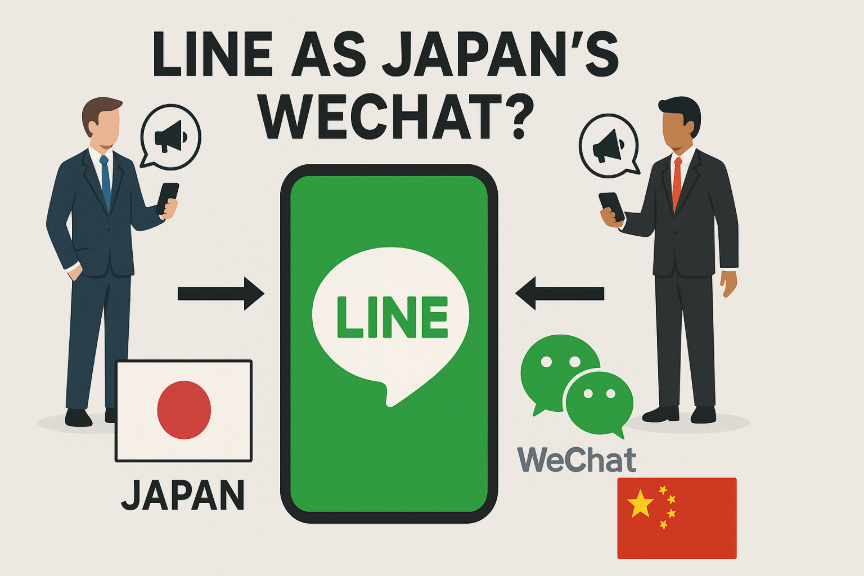
For low-cost acquisition in Japan, LINE can be a powerful channel—similar to WeChat’s role in China. Here’s how to localize your messaging and operations on LINE:
Build Customer Support and Communication Readiness
In Japan, the quality of inquiry response directly impacts brand perception. Fast and courteous support in Japanese is a major factor in earning trust. By establishing a bilingual (Japanese/English) communication setup, even overseas companies can provide a strong sense of reassurance.
By setting standards for response speed (e.g., within a few hours during business hours), preparing templates for common questions, and clarifying the scope of support, you can reduce drop-off during consideration and help move opportunities forward.
If you’re a D2C/consumer brand aiming to win Japan without physical stores, this case-based guide explains what works—from trust-building to logistics and UX:


Key Points for Leveraging Digital to Succeed in Japan
A common trait among companies that succeed in Japan is that they “understand the Japanese market and thoroughly localize.” Digital marketing is a powerful means to cross borders, but in Japan especially, strategy design must reflect language, culture, and search behavior.
By running the cycle of “research → foundation → execution → improvement” in the first 90 days, identifying winning patterns, and increasing repeatability, you can accelerate sustainable growth.
Summary
For overseas companies entering the Japanese market, the first 90 days are a critical period that can determine long-term success. By conducting market research and user understanding in days 0–30, building a Japan-localized site, content, and SEO structure in days 31–60, and running test marketing and improvement cycles in days 61–90, the probability of success in Japan increases significantly. Trust-oriented information design tailored to Japan is the first step toward results.